Art VII
Guppy: a new vision on the Genetics of Types (5-Epilogue)
RUBRIEK: Guppy Kweek English Translation

This and the previous publications on the genetics of the guppy types are of course primarily intended for those who closely monitor guppy breeding. For others this will not and cannot mean much. But part of the problem is that the world of guppy breeders is a rather closed world, running on its own and following its own necessities. Also the guppy clubs which in themselves do a good job of assisting the enthusiasts with word and deed, are a world apart that is embraced by the officially recognized guppy standards that are used as the norm and criteria for judging competitions and exhibitions.
On the one hand, it is fun and interesting to meet people who practice the same hobby, but on the other hand, there is also something limiting in it, when the outlines are put out in advance, and people are obliged to follow well-defined procedures. From that point of view, I have always been an unconventional guppy breeder, who does not want to walk these mapped out thinking and trading paths. For example, you will never see me keep my guppies in sterile aquariums in a garage, without bedding and plants; that is an unnatural environment for them. Before I grow " fancy guppies", I want to hold my guppies happy and healthy.
Sometimes I envy foreign growers in tropical areas like Central America and Asia, who can keep their guppies outdoors in tubs. Here this is only possible for 3 months a year - in summer. Foreign breeders have another advantage: fish that do not meet the requirements for further breeding can simply be "unloaded into the canal". It is an "public secret" in temperate regions what guppy breeders do exactly with their "surplus" of naturally healthy fish that they will not use for further breeding. I myself I give them out of necessity as food to my chickens, with a sincere "sorry" with it.
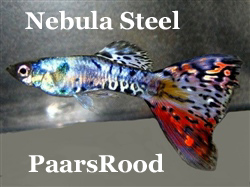

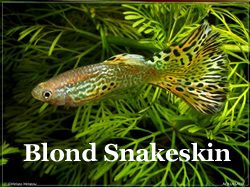
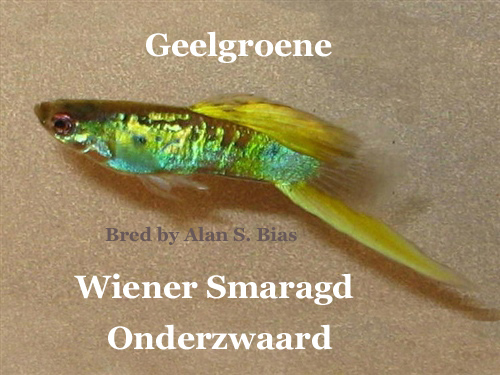

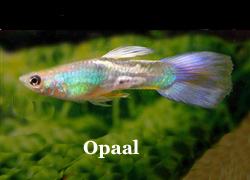

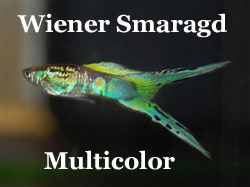
So the question is whether guppy enthusiasts will have read my article ca-refully, or will have only read it sideways. The guppies-for-exhibitions-breeding mechanism ----> fetching prices according to the predetermined standards ------> being able to ask a more expensive price for his prized animals, is deeply rooted in it. But these standards are actually quite arbi-trary, because the main emphasis is on the perfection of the tail shapes and the uniformity (= rigidity) of the strain. Not on harmony in color or har-mony in drawing. You may have already noticed that I compare the bree-ding of guppies with the making a painting : well, there composition and color palette are more important than the shape of the canvas.
My beloved landscape painter Bob Ross who has taught thousands of peo-ple the love and principles of nature painting with his TV series 'The Joy of Painting', illustrated this time and again:"Stay in the same color timbre, but do not be afraid to use intensive colors within it". If you look at many guppy creations, however, they look like failed paintings: too many colors mixed together, or poor composition, or no balance in colors or nuances in shades. Sometimes such guppies look as if they were made of cheap curtain fabric -flat and smooth- Sometimes they look like a neon or billboard, in contrasting and bright colors side by side. They lack nuances and depth; and also a harmony that every gup living in nature possesses.
The same Bob Ross used to say, "In painting there are no mistakes; only happy accidents." With which he wanted to clarify, not that one could not make mistakes (and in this case, with the advice: start all over again): but that one had to be guided by the process of painting itself. Let it happen. Instead of rigidly following "the plan". In the guppies "created" by humans, however, this is quite often seen: one starts from the plan of a strain, and works towards it.
The magic moment of the guppy breeding, time after time, however is when one experience the moment when the growing males get their co-lors , and one can see the "results" of his breeding appearing. For many a moment of disappointment, because they "are not there yet" (= the bree-ded fish do not yet meet the "goal" or plan). For me almost always a mo-ment of fascination: the wealth of the guppy to "escape" time and again from the preconceived plan, and to give something DIFFERENT. And instead of eliminating these "happy accidents" as undesirable, I will go into that and continue growing with them. My "plan" therefore changes during the breeding, because of the guppy itself. I also garden in the same way: I don't follow "my plan", but the hints of the garden and nature.
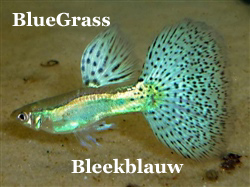

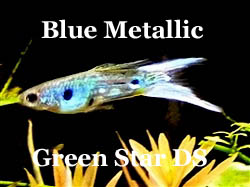
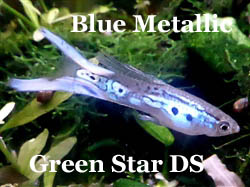
Two examples from my own guppy practice to illustrate this. In the fall of 2018, a new generation of blue-green double swords was growing up. My goal was to cultivate colors that were as pure as possible, which is why I normally select away samples with black spots on the body. But two males with spots turned out to have another nice feature: they got a metallic or silver shine over their entire body. As a result, they reflected from blue-green iridescent to metallic luster, reflecting as they moved in the light of the aquarium. And instead of being disturbing, the black drawings worked rather in-depth in this whole: as an extra layer in 3D. And last but not least, along with the play of lines and spots across the body, there is also a teal-blue radiating spot at the root of the caudal fin - which I named green star - which makes this guppies real gems.
When one encounters "something like that" in his (breeders) way, one must have the courage and the lucidity to change course, and to take a different course than foreseen. I have mixed up my breeding program, and made from this breeding my main goal.
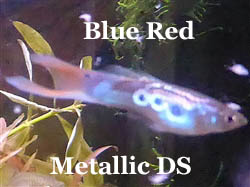
In the spring of 2019, something similar even repeats itself: with the growth of my blue-red double swords: between the different expected variations, two deviating specimens emerge. Their body was slightly more metallic reflective (but not as strong as the Green Stars), and the presence of red pigments makes this more like a pink-bronze shimmer. There is no question of the green star, but the few black spots on the body also show a 3D-dimension throughout the different layers, because that spot is "sur-rounded" by a metallic circle. And last but not least, the zigzag line on the back is drawn in a reflective pink-red that lights up when the fish is swim-ming. Here too, I changed my breeding program, and promoted these 2 together with their father (less pronounced but beautiful tail fin) to bree-ding males. The next generation may be disappointing, I anticipate that. It is now mainly a question of not letting these special gene combinations get lost.
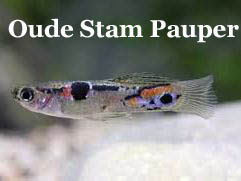

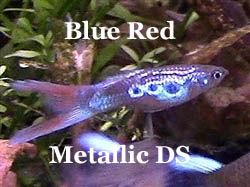
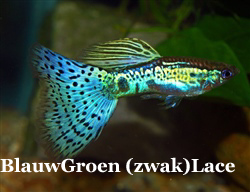
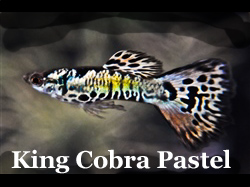
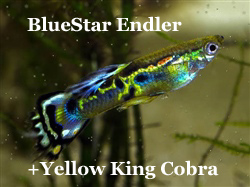
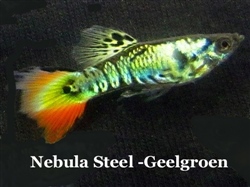
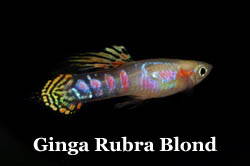
In every preference there is of course a subjective preference, so here abo-ve left a row of guppies that I like and is my subjective preference. But as I noted at the beginning: I also use objective criteria that go back to the richness of colors of the guppy itself, and to the harmonious color com-binations that can be found everywhere in nature. Hard, brightly contras-ting color combinations can be found in the same nature with a different signal function: as a warning (note: I am toxic!); or with another function: in a dark jungle or in very dark water, being able to find each other to mate (and a fish cannot attract auditory attention).
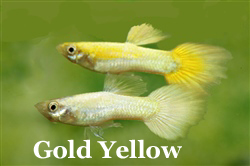
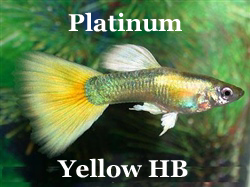
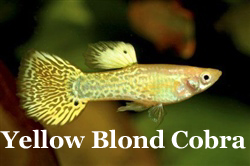
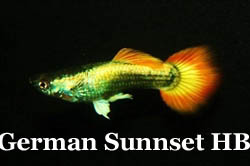
So here's the "fish-walk", with what I found the most beautiful guppies. It may well be that they will not score high on the assessment forms of the guppy clubs: there, the caudal fin and the consistency of the stock stan-dards are mainly paid attention to, which is often at the expense of the colors and color-harmony. With those "new" guppies it is therefore about the intensity and the interplay of the colors, which often comes at the expense of an (extended) tail shape. And the scope for variability is so great that this is often at the expense of the uniformity of the strain. It's creati-vity and playfulness versus norms and rigidity. It is therefore up to you to decide HOW you will breed guppies. The expertise remains the same, and so does the knowledge; in fact, one should even have a better understan-ding of the genetics hidden behind the specific appearance of a guppy.
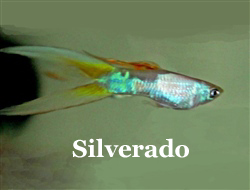
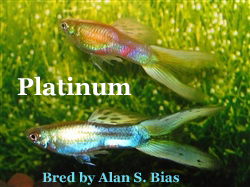
This REAL understanding of genetics can also help clear the confusing assumptions. For example, I have noticed that the terms metallic , silver , platinum and gold are loosely mixed up used. For example, a blonde guppy with yellow and the platinum genes will have a golden fore body. But the same platinum genes in a "normal" guppy with blue-green can in turn yield a (partly) silver, metallic shiny fore body. So it seems that depending on the strain, the same genes have been given an different name, instead of determining their scope THROUGHOUT the different strains. One cannot just attribute every 'new' mutation to a new gene: the combinations are infinite, but the number of genes is not, not even in the guppy.
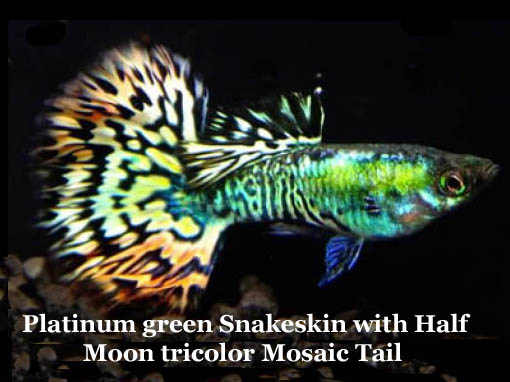
Finally, a number of generally accepted assumptions appear to be not en-tirely true. The "sex-linked" genes - mainly those on the male Y chromo-some - do exist, but do not appear to play such a decisive role. For exam-ple, the snakeskin property is often presented as Y-linked. That may have played its part in the development of this strain, but in my practice with my snakeskins for example, this does not appear. I grow my snakeskins on blue-green. This means that I eliminate males with yellow and red in their tail fin for further breeding. This is already the 6th generation, in which I cross back blue males with females that come from the same litters. Yellow and red are dominant over blue and green, so males with these color genes will always show this in their appearance. Well, then it should be impossi-ble that males with yellow and red still show up regularly. The reason is simple: it "comes" from the females (who are not so easy to identify in that area). So the snakeskin inheritance is not passed down purely in the male line. So the females ALSO play an important role in the male line. In the world of guppy breeders, there may come well a female emancipation pro-cess, literally and figuratively.